
The Household as Workplace
Chanson douceThe novel traces how domestic labor makes the employers’ comfortable private life possible while keeping the worker’s own needs unseen.
increasing Bearing strength in each event
 decreasing
Bearing strength in each eventdecreasingEmployers Prepare

Establishing the Hierarchy
The apartment is staged
Myriam and Paul clean before candidates arrive, gathering clutter and trying to present themselves as respectable employers. They want the women to understand that they are the bosses.
A revealing performance
Their anxiety about appearances coexists with assumptions about candidates’ immigration status, children, and availability. The hiring scene makes class power part of the family’s ordinary self-presentation.
Invisible Competence

Work That Looks Like Magic
Tasks disappear into results
Laundry is mended, meals prepared, rooms organized, and children calmed. The employers see a transformed home but not always the time and energy required to produce it.
Praise obscures labor
Calling Louise a fairy or a perfect nanny makes her skill admirable while disguising its material cost. The language of magic turns paid work into a personal gift.
Dinner Without the Worker

Praise and Exclusion
The cook is applauded
Louise’s dishes draw admiration, and Paul presents her as the family’s exceptional nanny. Conversation soon moves elsewhere while she cleans alone in the kitchen.
Being present but unseen
The dinner condenses the novel’s class dynamic: the worker is included as a topic and valued for what she produces, yet is not treated as a full participant in the gathering.
A Promise of Holiday

A Gift That Requires Work
Inclusion announced
Paul declares that the family will take Louise on holiday, and Myriam welcomes the prospect of easier childcare. The offer sounds like recognition of Louise’s contribution.
The job travels too
Louise shares the children’s room and remains responsible for their care. The vacation blurs employer and family boundaries without changing who carries the work.
The Workers’ Square
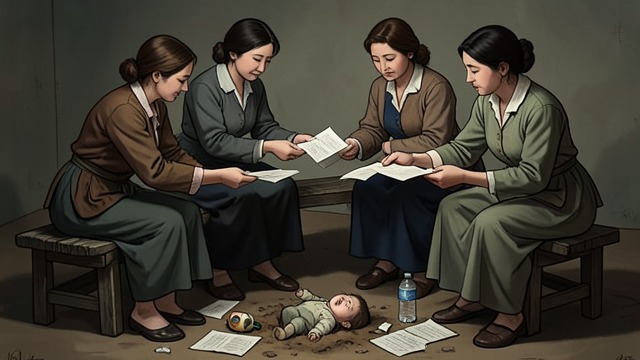
A Collective World of Care
Nannies meet and exchange news
At the square, caregivers share job leads, complaints, and information about employers. Their conversations form an informal labor network beneath the children’s play.
A wider social pattern
Louise’s story belongs to a larger group of women whose names and languages disappear from the families they serve. The square makes visible the shared conditions hidden inside separate households.
The day of the nanny interviews
The first weeks of Louise’s work
At the first celebrated dinner with friends
The night Paul invites Louise on vacation
During the seasons Louise takes the children outside
